
YOGI PRIYAVRAT ANIMESH: BEYOND WHAT THE EYES CAN SEE
Founder- OOJ Foundation
The Invisible Architecture of an Inner State: An Exploration of Consciousness Through the Timeless Wisdom of Indian Yoga
New Delhi | 3 October 2026
(What appears before the eyes is not the entirety of an experience. Beyond the visible body, beyond the smile, beyond words and even beyond silence lies an inward movement of consciousness that Indian Yoga has explored for millennia. Yogi Priyavrat Animesh reflects on that unseen journey from the visible to the Seer, from Vṛtti to Sākṣī, from the finite to Bhūmā, and ultimately toward the eternal inquiry: “Ko’ham?” Who am I?)
What Is Visible Is Not the Entire Event
The Invisible Architecture of an Inner State: An Exploration, Through the Vision of Indian Yoga, of That Inner Realm Where the Visible Does Not End, but Turns Back Toward the Seer
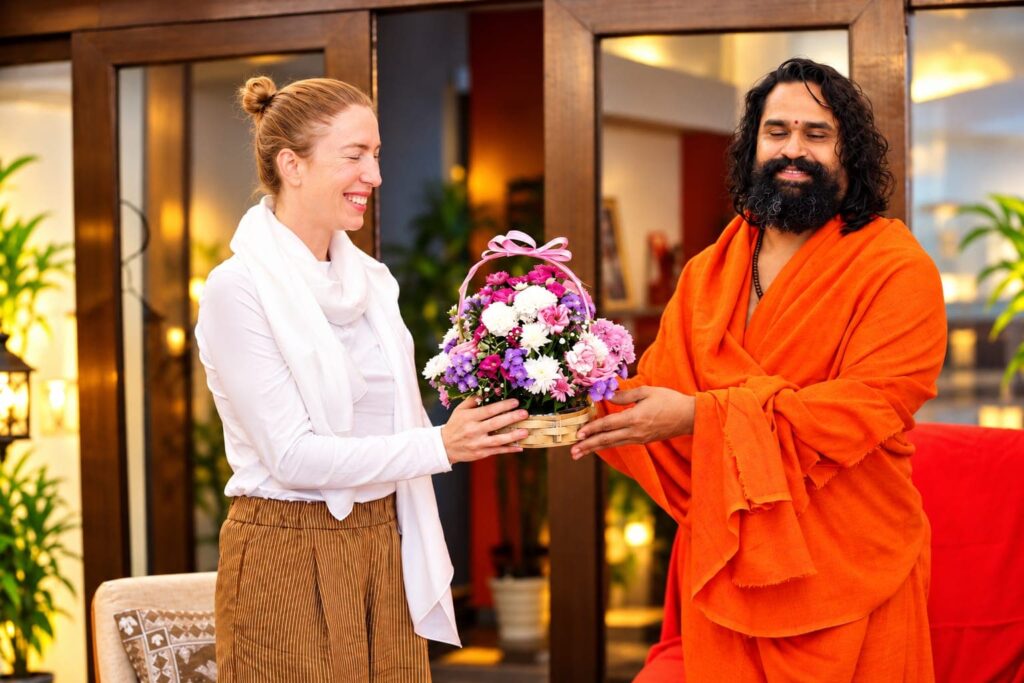
At times, a state arises spontaneously within a human being whose outward appearance is remarkably simple. The eyes gently close, a natural serenity descends upon the lips, the breath continues in its effortless rhythm, and the present moment seems, for a while, to lose its ordinary movement. To an outside observer, it may appear merely as a beautiful smile, an emotional meeting, or a moment of heartfelt welcome. The camera, too, can capture only this much: the expression, the position of the hands, the flowers, the light, and the body. Yet the vision of Indian Yoga does not stop here, because for Yoga, what is visible is never the entirety of the event. It asks: when the eyes withdrew from the outer scene, where did vision go? When serenity appeared upon the face, who was aware of that serenity? And when words became irrelevant for a few moments, was that silence merely the absence of speech, or was consciousness entering some subtler region of itself?
The answer to this question cannot be obtained by speculating about another person’s inner world. The discipline of Yoga itself teaches that experience is not to be imposed upon another; it is to be directly realized. Therefore, to call closed eyes Samādhi would be as careless as declaring a smile to be definitive proof of Ānanda. Yet through these visible signs, we may certainly begin to understand the classical inner map that the Indian yogic tradition has explored within the human being for millennia. The first mystery of that map is this: everything that happens within us is not necessarily what we are, because alongside everything that happens, there is also the awareness that it is happening.
A thought arises and is known. An emotion appears and is known. Happiness comes and is known. Sorrow comes and is known. The breath enters, the breath leaves, and in awareness even its subtle movement can be known. If all these are objects of knowing, then Indian Yoga raises an extraordinarily subtle question: Who is the Knower?
It is here that Patañjali’s aphorism ceases to be merely a sentence in a scripture and becomes an entrance into the inner world: “Yogaś citta vṛtti nirodhaḥ.” Yoga points toward the stilling of the movements of citta. Immediately thereafter comes the revelation of the purpose of that stillness: “Tadā draṣṭuḥ svarūpe avasthānam.” Then the Seer abides in its own essential nature. Between these two aphorisms lies the entire direction of Yoga. The purpose is not merely to make the mind silent. The purpose is to recognize, within that silence, what it is that knows the movement of the mind. Thus, when the eyes close, what matters to Yoga is not simply that the external scene has disappeared. The deeper question is whether consciousness has begun to turn away from the object and toward the very process of seeing itself.
If such an inward turning begins, the senses do not become enemies, nor does the world become something to be rejected. Only the direction of the flow changes. Ordinarily, citta continually flows toward form, taste, fragrance, touch, memory, desire, and reaction. Yoga introduces a subtle interval into this outward movement. In Patañjali’s language, this is the mystery of Pratyāhāra: not the destruction of the senses, but their release from enslavement to their objects; not the rejection of the outer world, but the remembrance of the inner one. When the eyes close, darkness may appear, but Yoga is not searching for darkness. It is searching for that reality to which both light and darkness are known.
As soon as the practitioner begins to experience that one is not compelled to be carried away by every thought, a new interval appears within citta. Earlier, thought and “I” seemed identical: “I am sad,” “I am happy,” “I am afraid.” Now a subtle distinction begins to reveal itself: sorrow is present, and awareness of sorrow is also present; happiness is present, and awareness of happiness is also present; fear is present, and there is also an awareness that witnesses it. This is the first discernment between the seen and the Seer. It is not yet Self-realization, but it is certainly the birth of Self-inquiry.
With the birth of Self-inquiry, the human question itself changes. One no longer asks merely, “What is happening to me?” One begins to ask, “Who is the one to whom all this is happening?” Here the ancient inquiry of the Kena Upaniṣad begins to resonate within: “Keneṣitaṁ patati preṣitaṁ manaḥ?” By whom is the mind impelled to move? What is that ground because of which the mind thinks, prāṇa moves, speech speaks, and the senses apprehend their respective objects? The question has moved from outside to within. The search is no longer for an object. It is now for the Knower itself.
This journey toward the Knower begins to move from the gross toward the subtle, and the doctrine of the kośas in the Taittirīya Upaniṣad offers an extraordinary map of this progressive refinement. The first experience is of the body, Annamaya; within it lies the field of vital movement, Prāṇamaya; subtler still is the realm of thought, intention, emotion, and mental formation, Manomaya; subtler than this is the dimension of discernment and understanding, Vijñānamaya; and finally there is the indication toward Ānandamaya. To understand these as five physical layers of modern anatomy would be a mistake. They constitute a philosophical map of progressively subtler dimensions of experience. They ask: what you have always called “I,” is it merely the visible body? If not, is it merely the breath? If not, is thought its ultimate nature? And if thought itself can be observed, then where is the Seer?
With this question, the meaning of breath also begins to transform. Earlier, it was simply the involuntary biological movement of life. Now the same breath can become a bridge between the outer and the inner. The body exists outwardly in the world; the mind wanders inwardly among memories and imaginations; yet the breath continually joins both within the present moment. Therefore, in Yoga, the observation of prāṇa does not remain merely an observation of air moving in and out. It becomes a means of establishing awareness in the present. A subtle breath does not necessarily mean that something supernatural is occurring. Yet if awareness becomes subtler along with the breath, the practitioner may begin to witness for the first time the continuous mental noise that had previously been mistaken for the Self.
As soon as the noise becomes visible, some distance from it becomes possible. When distance becomes possible, Dhāraṇā is born. Scattered consciousness learns to remain upon a single point. When that Dhāraṇā, instead of repeatedly breaking, acquires an uninterrupted continuity, the field of Dhyāna opens. Here effort gradually transforms into flow. Meditation does not mean fleeing from the world. It is a condition in which consciousness gathers its scattered energies and begins to see itself with greater clarity. Within this clarity, an extraordinary transformation becomes possible: the source of that which we have always sought outside begins to be questioned within.
It is here that the mystery of Ānanda comes before us.
If happiness were contained solely in an external object, the same object would give the same happiness to every person at every time. Experience tells us otherwise. That for which the mind once desperately longed may, after being obtained, become ordinary. Even in the presence of circumstances once believed to guarantee happiness, the mind may remain disturbed. The Upaniṣads therefore lift the search for happiness from the object toward Being itself. The Chāndogya Upaniṣad declares: “Yo vai bhūmā tat sukham.” That which is Bhūmā, the limitless, is happiness. This is not a rejection of worldly happiness. It is a transformation in the direction of the search for the ultimate ground of happiness: from the limited toward Bhūmā, from dependence toward essential nature, from acquisition toward Being.
And then our way of looking at spontaneous serenity upon a face also changes. We do not claim to know the inner state of another person. Instead, the visible moment awakens a question within us: does happiness always travel from outside to inside, or can there also be moments when some inner knot loosens for an instant and Ānanda expresses itself outwardly upon the face? Is every smile merely a reaction to an event, or can it sometimes be the expression of the mind becoming momentarily weightless? Here Yoga does not impose an answer. It offers a discipline: see for yourself.
This is the extraordinary method of the Indian Ṛṣi tradition. Its ultimate invitation is not merely to believe, but to move toward knowing. Yet this knowing is not the act of placing the Self before oneself as an external object and observing it. It is the descent into the very centre of experience. The human being becomes the field of inquiry; breath becomes an instrument; concentration becomes discipline; discernment becomes examination; silence becomes the field of profound observation. This is why reducing Yoga merely to Āsana is to compress an immense inner science into a bodily posture. Āsana is visible. The subtler journey of Yoga begins where the visible body itself becomes a doorway into the inner world.
It is precisely here that an extraordinary dialogue becomes possible between the modern world and ancient Indian insight. Humanity has created remarkable instruments for looking outward. The light of distant galaxies can be captured, the minute structures of cells can be observed, and many biological activities of the brain can be measured. Yet every piece of knowledge acquired through any instrument ultimately appears within conscious experience. Science possesses its own distinctive and indispensable methodology for investigating objective processes; Yoga need not replace it. Yoga raises another question: How does experience reveal itself from within, and how may the one who knows experience be investigated?
Here the universality of Indian Yoga is born. It need not remain confined within the cultural boundaries of any one country, because the fundamental question of the inner world it explores arises from the condition of being human itself. A woman may travel from America to India; before her may stand a practitioner or Yogi rooted in India’s yogic tradition. Their mother tongues, histories, cultures, and life journeys may be entirely different. Yet when attention comes to the breath, the breath does not ask which passport one carries. When the mind becomes silent, silence requires no translation. And when the question “Ko’ham?” arises within, it belongs neither to East nor West. It becomes a question of human existence itself.
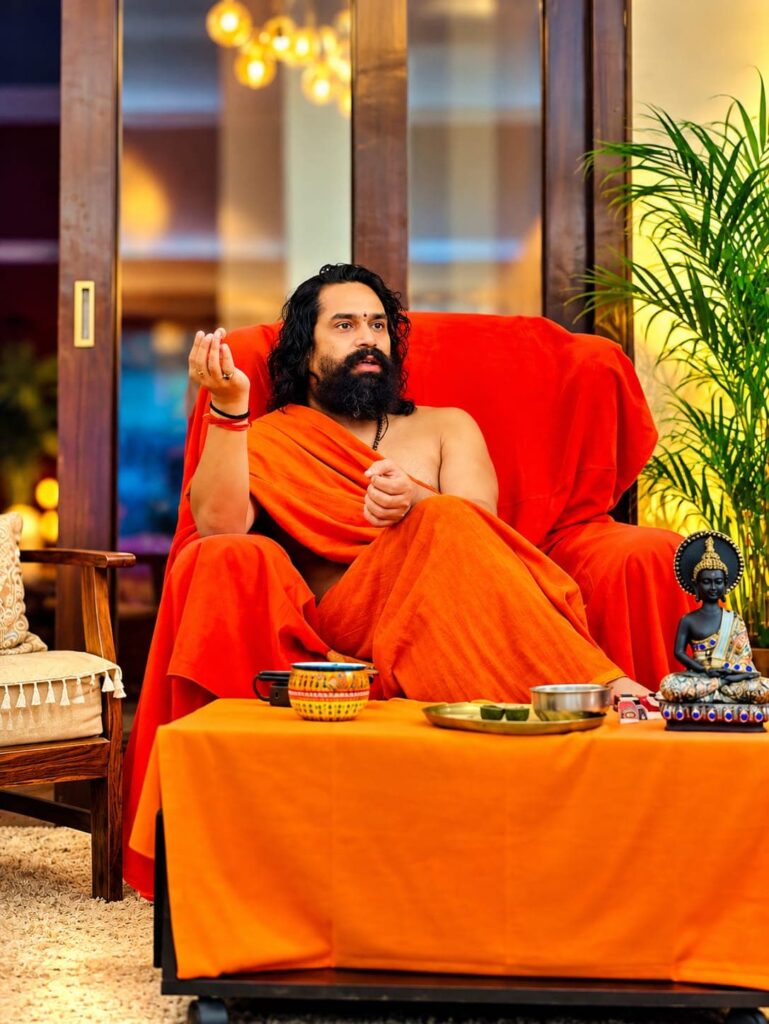
And it is here that the deepest meaning of a Yogi’s presence begins to reveal itself. The purpose of a Yogi is not to establish authority over another person’s inner world. In the higher tradition of Yoga, Sannidhya, spiritual presence, means creating the possibility for another human being to return within. If the Guru merely gives an answer, inquiry may end. But if the Guru’s presence awakens within a person a question whose answer cannot be borrowed, then the search begins. The Guru is no longer the final destination, but a remembrance of the inner doorway. His presence does not seem to say, “Look at me.” Rather, it silently asks: Look within yourself at the Seer who is looking at me.
At this point, the nature of communication between two human beings begins to change. At first there was communication through words: names, introductions, questions, answers, countries, journeys, and experiences. Then there may come a moment when words no longer seem sufficient. Such silence is not proof of mysticism. It is a common yet profound possibility of human experience: certain states are larger than linguistic expression. In a mother’s gaze, in the touch of someone deeply loved, in wonder before profound beauty, or in the stillness of meditation, one recognizes that the entire dimension of experience cannot always be contained within a sentence. Indian Yoga reads this limitation not as the defeat of language, but as the entrance into silence.
And when silence deepens, the ordinary structure of “I” also enters the field of observation. My name, my country, my body, my story, my achievements, my sorrows: all these are real, but do they constitute the entirety of my Being? The “Neti, Neti” of the Bṛhadāraṇyaka Upaniṣad becomes luminous here. Not this, not merely this. It does not mean declaring every limited identity false; rather, it means seeing that no single limited identity can exhaust the totality of the conscious reality that knows it. The body exists, but I know the body. Thought exists, but I know thought. Memory exists, but memory too appears within my awareness. Then the same question returns, now purified: Who am I?
This time “Ko’ham?” is no longer a philosophical ornament. It becomes the direction of consciousness itself. The deeper the question descends, the less useful a collection of borrowed answers becomes. To say “I am the Ātman” and to directly realize the nature of the Self are not the same thing. Scripture can indicate the direction, spiritual discipline can prepare the ground, and the Guru can point toward it, but experience cannot be borrowed from another. This is why Indian spirituality developed the movement from Śravaṇa to Manana, and from Manana to Nididhyāsana: to hear the truth, to clarify it through contemplation, and then to allow it to descend into the depth of Being.
Then the question of the Self gradually transforms the question of relationship as well. If I am not merely my limited story, then the person before me cannot be merely his or her limited story either. This understanding opens the doorway toward the Upaniṣadic vision of non-separation. When the Īśā Upaniṣad speaks of seeing all beings in the Self and the Self in all beings, it does not destroy diversity. It reveals the possibility of a deeper unity beneath diversity, within which the existence of another is no longer absolutely alien to me. Compassion then need not remain merely a moral command. It can become the natural consequence of vision.
And it is precisely here that the small exchange of flowers becomes a vast symbol. The flower was in the hand of the giver and then reached the hand of the receiver, but its fragrance did not remain the property of either. It spread into the space between them. In the same way, if an authentic spiritual presence occurs, the giver and receiver gradually become secondary; what becomes primary is the space between them, the openness in which both may, for a few moments, become lighter than their respective mental narratives and simply be present. That presence may be called reverence, friendship, peace, or Ānanda, and sometimes no name is required at all.
As the need for naming diminishes, language itself approaches its limit. The Māṇḍūkya Upaniṣad, pointing toward Turīya, speaks of it as “Prapañcopaśamaṁ śāntaṁ śivam advaitam”: the cessation of phenomenal multiplicity, peace, auspiciousness, non-duality. To impose these words upon the state visible in a photograph would be inappropriate. Yet they remain among the highest scriptural indications of the direction toward which Indian Self-inquiry seeks to guide the human being: where the experiencer is no longer merely another object within experience, where consciousness turns toward its own ground, and where the ordinary insistence upon separation begins to lose its rigidity.
Now the original scene returns before us, but its meaning has changed. The flowers are the same, the two human beings are the same, the closed eyes are the same, the serene face is the same. Yet we now understand that the visible is only the outermost layer. Behind it is the body; within the body, the movement of breath; with the breath, the waves of mind; behind the mind, the possibility of discernment; behind discernment, the question of witnessing; and beyond that question, the great Self-inquiry before which the Ṛṣis asked millennia ago: Who is seeing? Who is knowing? Who am I?
And perhaps this is the true mystery of the scene: the mystery is not imprisoned within the woman’s closed eyes, nor within the personality of the Yogi, nor in the flowers, nor in the camera. The mystery lies in the question that this scene can awaken within us. Because the moment we move from trying to understand another person’s experience toward investigating the Knower of our own experience, the image ceases to be merely an external object and becomes a mirror.
In that mirror, America and India are still visible, but behind them appears the human being. Behind the human being appears the mind. Behind the mind appears the question of the Witness. And behind that question opens a silence in which Sanātana Dharma’s most ancient inquiry becomes alive again before the modern human being.
Who am I?
If this question is merely read, it is philosophy. If it is contemplated, it becomes inquiry. If one sits with it inwardly, it may become the beginning of Sādhanā. And if someday the one who asks becomes so transparent in the fire of the question that an answer is no longer demanded in words, Indian Yoga points toward a silence that cannot be displayed from outside.
The camera cannot reach there.
It sees only the closed eyes.
But Yoga asks: Who is seeing behind those eyes?
The camera sees the smile.
Yoga asks: Where is the source of Ānanda?
The camera sees two human beings.
Ātma Vidyā asks: What lies at the ground of apparent separation?
And when these three questions begin ultimately to dissolve into a single centre, one begins to understand that the great mystery of Indian Yoga does not lie in extraordinary display, but in this silent inward turning of human consciousness.
From the outer to the inner.
From the seen to the Seer.
From Vṛtti to Sākṣī.
From the limited to Bhūmā.
From word to silence.
And ultimately, from “Ko’ham?” toward that experience in which perhaps even the question begins to return to its own source.
Here the eyes close, but Darśana does not end.
Here words become still, but communication does not end.
Here two cultures meet, but neither is required to abandon its own form.
Here the human being does not flee from the outer world. Rather, for the first time, one enters that inner universe through which the experience of the entire outer universe becomes possible.
And perhaps this is the true meaning of the global journey of Indian Yoga: not to impose a doctrine from India upon the world, but to guide every human being, irrespective of country, language, or culture, toward that timeless question within the depths of one’s own consciousness, a question created neither by East nor by West, but one that every awakened human being may one day ask:
“Ko’ham?”
And when that question truly descends within, the journey no longer moves toward any geography.
The journey returns to the Seer.
Tadā draṣṭuḥ svarūpe avasthānam.